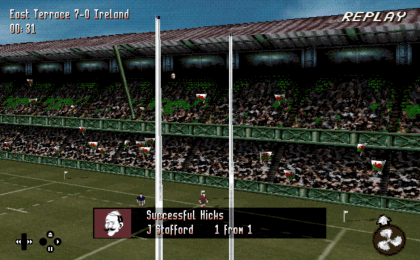
In 1997 New Zealand’s Jonah Lomu was at the peak of his fame. Video game publishers Codemasters licensed his name for a video game that has become a cult classic in the rugby community and is one of the most important pieces of rugby union pop culture of all time.
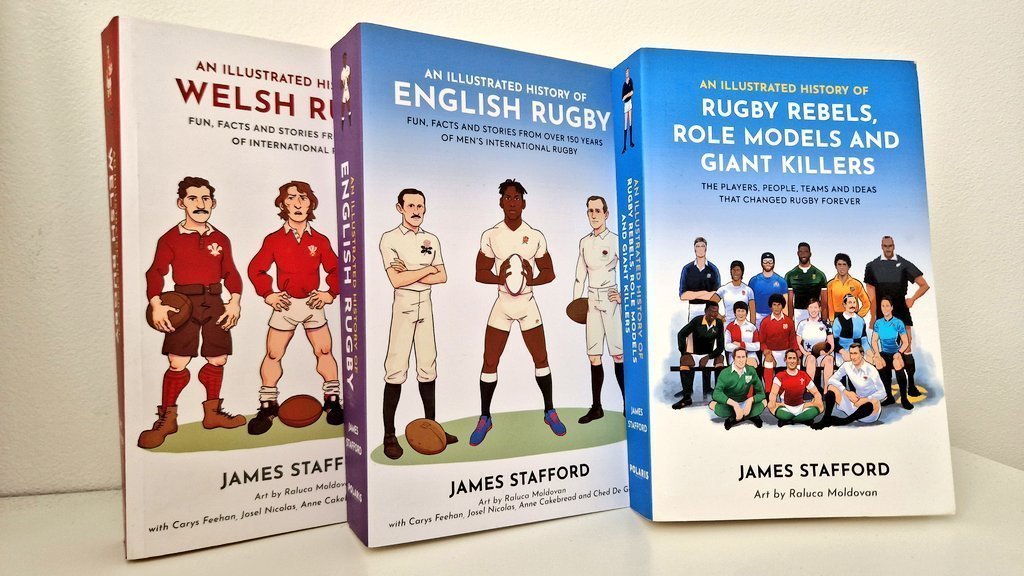
Note: The following article is an adapted chapter taken from James Stafford’s ‘An Illustrated History of Rugby Rebels, Role Models and Giant Killers‘, which features a digital Jonah Lomu on the cover. If you enjoy this article, please consider supporting The East Terrace and buying this book.
Platforms: Sony Playstation, Sega Saturn, MS-DOS Developer: Rage Software
Publishers: Codemasters Release year: 1997
Jonah Lomu was one of the most important figures in the history of rugby. A genuine icon, his ‘arrival’ on the world stage in the 1995 World Cup with New Zealand was unlike anything else ever seen in the sport. His superhero-like exploits in that tournament, including his celebrated four-try effort against a helpless England, catapulted him to household-name status.
The 196cm (6ft 5in) and 120kg (18st 13lb) winger, was a revelation. Despite his bulk and size, he was faster off the mark than anyone in the All Blacks squad. Lomu was labelled a ‘freak’ by England captain Will Carling due to his combination of speed, size and raw power.
Born in Auckland and of Tongan heritage, Lomu was the first global rugby superstar. He appeared in everything from Pizza Hut commercials to McDonald’s adverts and became an ambassador for Adidas, where he hung out with fellow brand stars such as Russian tennis star Anna Kournikova.
But one of the greatest and most fondly remembered aspects of his legacy wasn’t what he achieved on the playing fields, as great as that was. Rather, it was a video game bearing his name.
Jonah Lomu Rugby was released in 1997 for the Sony Playstation, Sega Saturn and MS-DOS. It remains one of the most significant moments in modern rugby popular culture and marked the first time a player’s name was licensed for a rugby title.
It was, quite simply, a phenomenon.
‘Big Bloke. Big Game.’
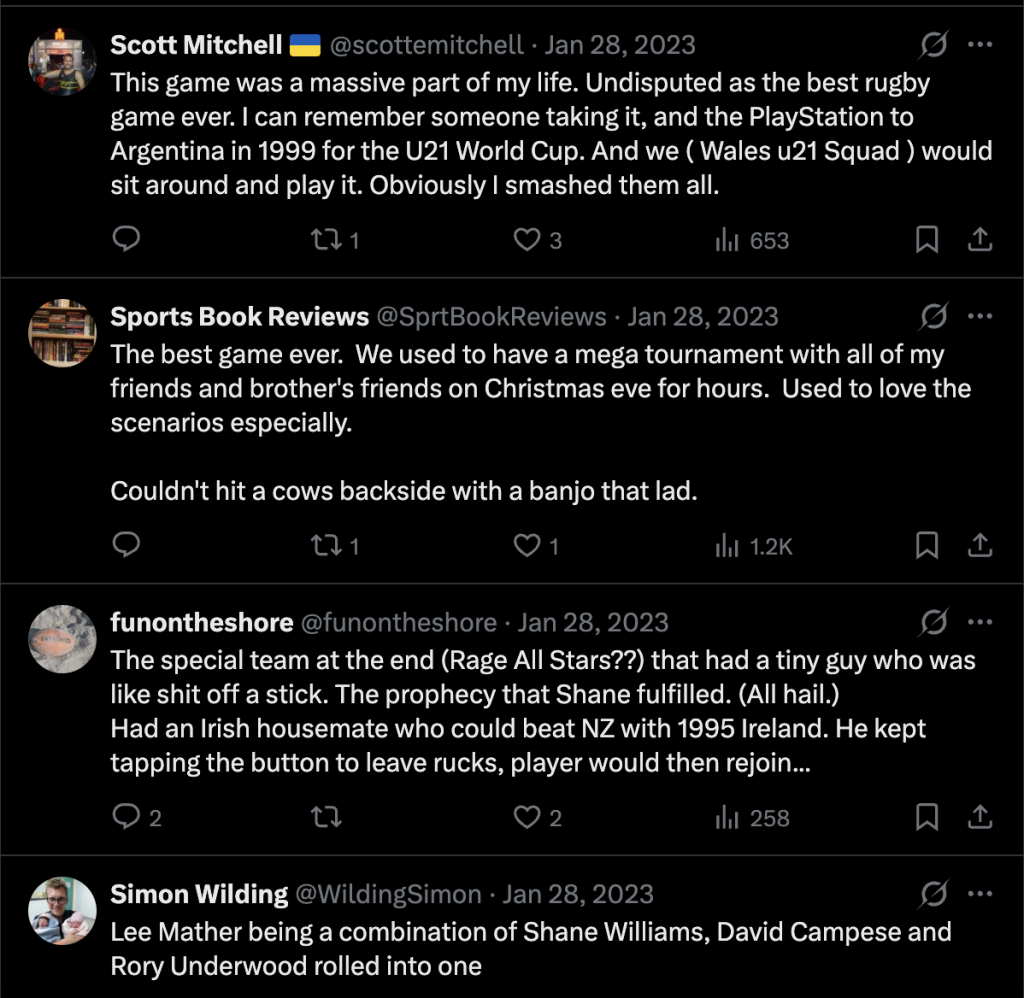
In 2023, preparing for his book ‘An Illustrated History of Rugby Rebels, Role Models and Giant Killers‘, the East Terrace editor posted a tweet asking for other rugby fans on Twitter to share their memories of the game.
I’m planning a very special feature on the classic Jonah Lomu Rugby #Playstation game for a special book I’m working on.
If you’ve got memories of it you would like to share, chuck them into this thread. And please share this tweet if you can. #JonahLomuRugby pic.twitter.com/bRoe79HpCZ
— James Stafford 🇺🇦 (@jpstafford) January 27, 2023
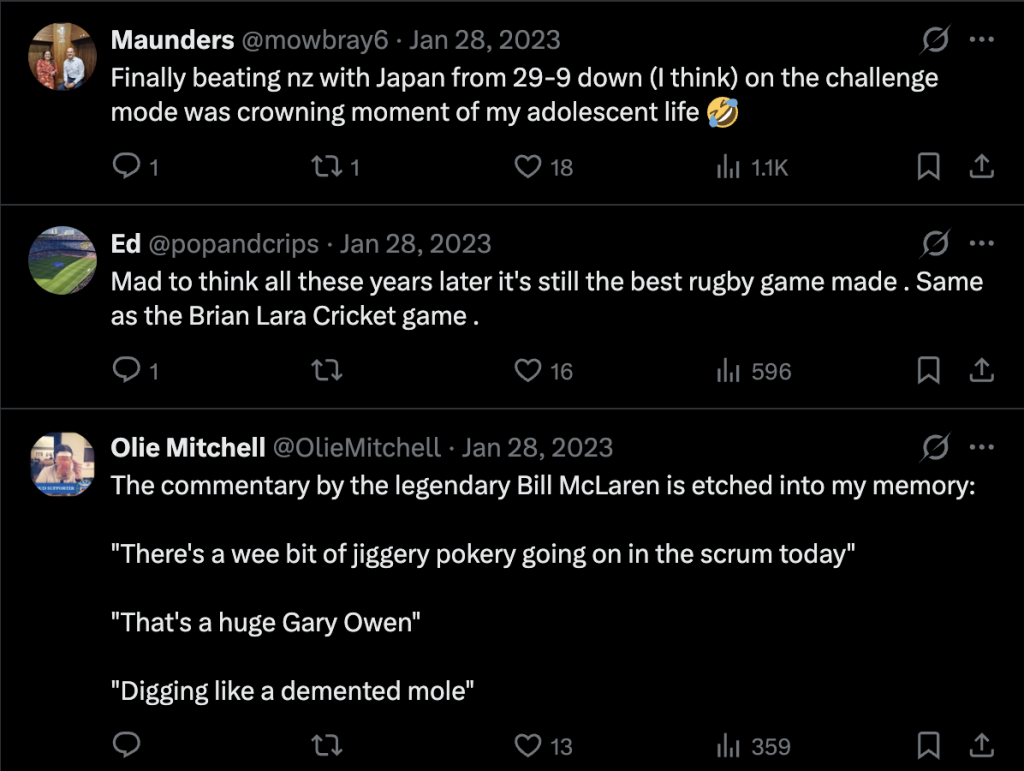
The response was astonishing. The post was viewed over 250,000 times and received hundreds of passionate comments in a digital outpouring of joy and nostalgia. You can click on the post above to see the full thread of responses, but a few are sampled here.




The making of a cult game
Created in the UK, Jonah Lomu Rugby was coded by Rage Software and published by Codemasters.
The genius of it was that it avoided the trap so many other rugby games have fallen into. It did not try to make an accurate simulation of rugby, it rather went for arcade-style gameplay that captured the essence of the sport, but was easy to pick up and play. It smartly made up for its decision to ‘simplify’ the sport by being incredibly well executed, fast and unbelievably fun.
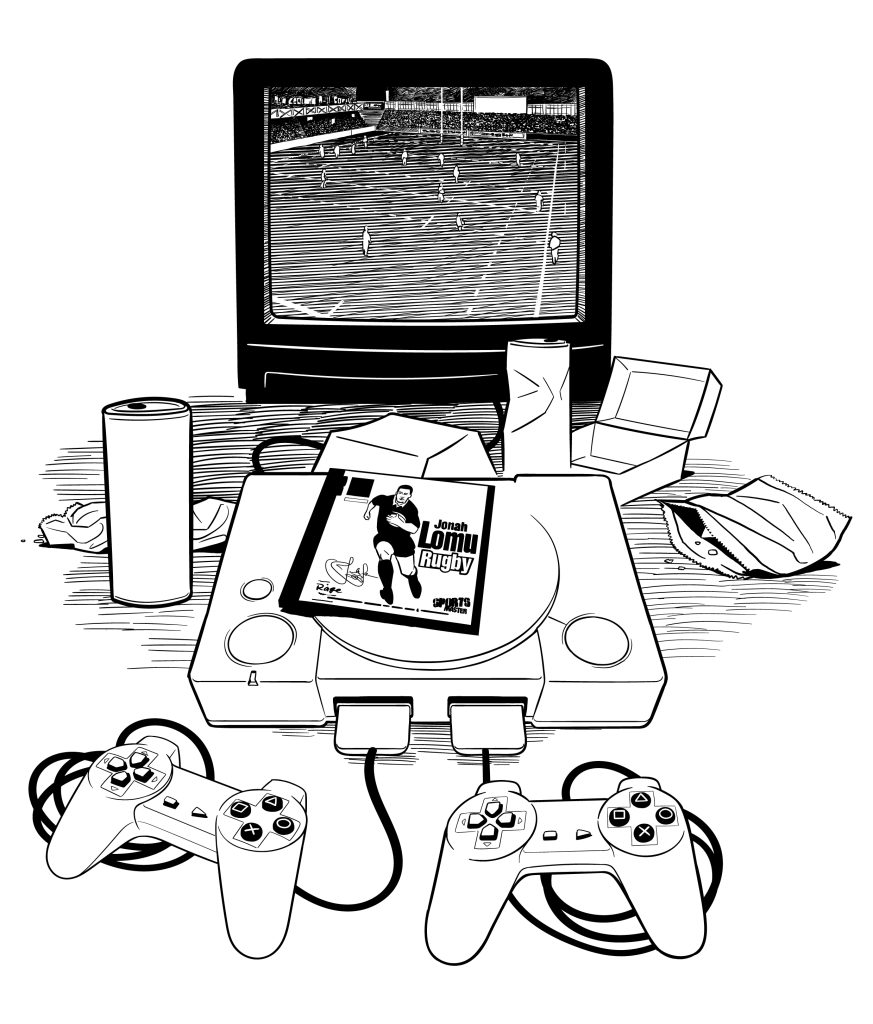
Art by Raluca Moldovan from the book ‘An Illustrated History of Rugby Rebels, Role Models and Giant Killers’.
In 1997, Trevor Williams of Rage Software explained this concept in an interview with Sega Saturn Magazine: ‘We wanted a game that stayed true to the rules, but was easy to pick up and play without a complete understanding of all [rugby’s] ins and outs.’
This is something that Lee Mather, a 19 year old who was working at Rage at the time, agrees with. Mather helped compile the stats for the players in the game (showing the age of the game, books were the main reference sources for player info), but also worked as a general office administrator, doing everything from burning discs to game testing and IT tasks.
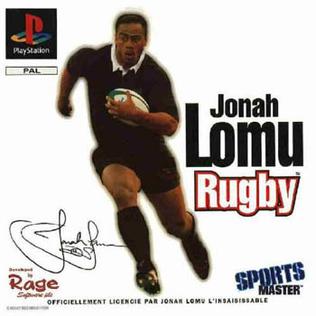
Cover art for the Playstation version of Jonah Lomu Rugby.
He was not a rugby fan, but soon found himself enjoying it too. ‘Yeah, it was that fact that anyone could sit down, pick it up and play it,’ he says.
‘And there were people that weren’t rugby fans sitting down and playing it in our offices. It really was for anyone.’
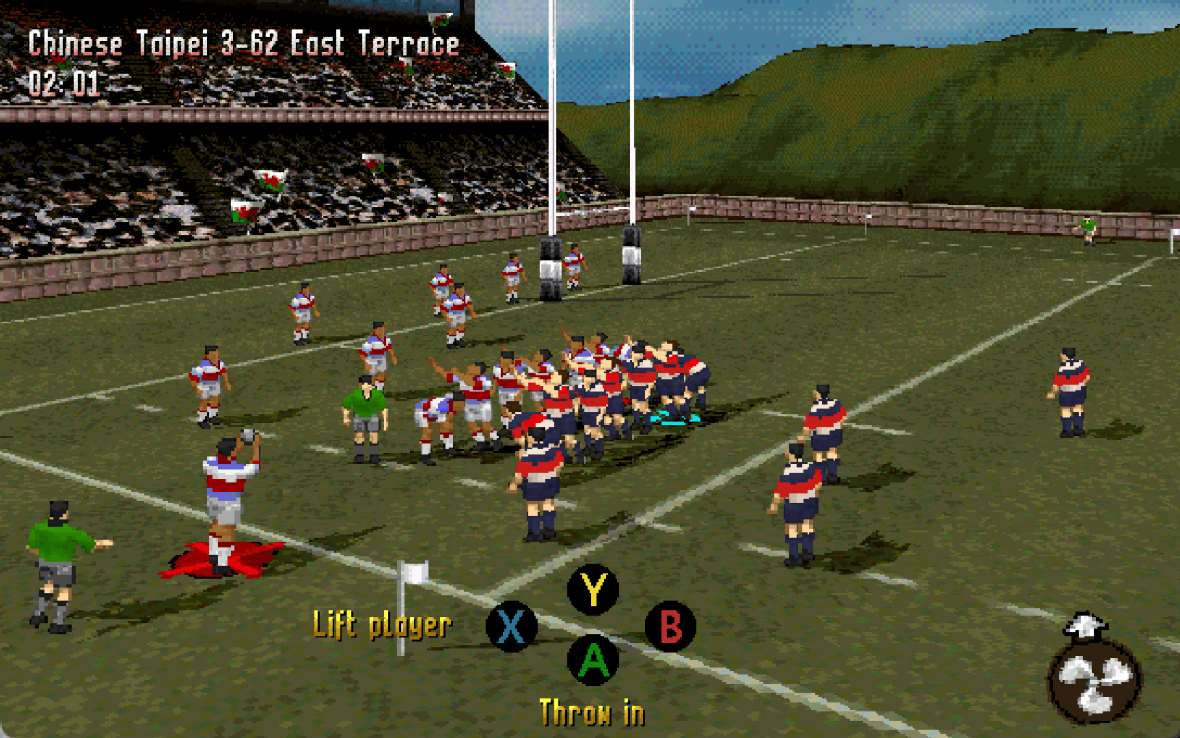
The developers wisely decided to avoid using polygons or other memory-draining graphical techniques, and instead opted to use an engine that was sprite based. This both allowed for the game to perform well and at speed, while also giving it a unique, fun, almost cartoon-like visual appeal.
‘If I remember correctly,’ recalls Mather, ‘all the animations were done on super high-end silicon graphic workstations and then brought down to a level that was usable on consoles with the memory that was then available.’
Rugby was, and remains, a notoriously difficult game to reproduce digitally due to its complicated laws and highly specialised positions and tactics. Yet the approach of Rage to the project was so brilliant that the game achieved such a cult status that a copy of it now sits in the Museum of New Zealand (Te Papa Tongarewa) as part of its Pacific Cultures Collection.
The museum website states: ‘As an artefact of popular culture, this video game helps us document the history of Pacific Islanders in sport but also how some became the marketing face of rugby both in New Zealand and internationally.’
It’s in the game
Jonah Lomu Rugby (or Great Rugby ’98 as it was known in Japan) allowed players to play on their own against the computer or head-to-head with other human players (up to four people could play simultaneously).
Gamers could choose from friendly mode, World Cup mode, Tournament mode, Territories Cup mode (this included tournaments such as the Five Nations, Tri Nations and Pacific Cup) and Classic Matches. The latter mode dropped players into a famous moment in a real historical rugby match and asked them to change the outcome.
These challenges are a fondly remembered part of the Lomu formula. They ranged from the relatively simple (help New Zealand win the 1995 World Cup in extra time) to the insanely difficult (guide Japan back from 24–3 down against the All Blacks in the second half). The Brave Blossoms, of course, had lost to a second-string All Blacks 145–17 in real life during the 1995 tournament.
Completing these tasks would unlock special teams and modes, including the ‘Extra Cup which featured the Codemasters, Rage All-Stars and Team Lomu sides.
The gameplay itself was a delight and a smart, intuitive control system meant that while new players could pick up the basics very quickly and start having fun, the more hardcore players who persevered would be rewarded by the depth of gameplay.
A serious veteran of Jonah Lomu Rugby will always be happy to regale a captive audience with the strategies, tactics and techniques they developed to take their play to the next level. Mather recalls how key it was that the developers nailed the flow and controls.
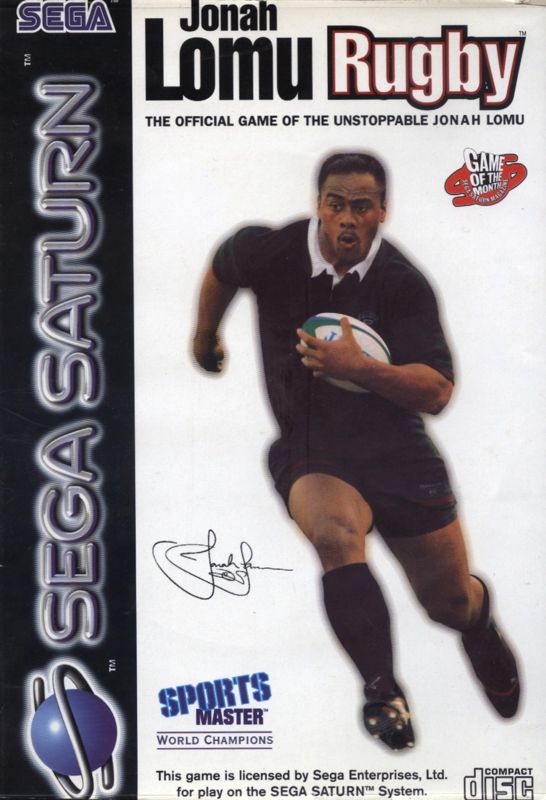
Cover art for the Sega Saturn version of Jonah Lomu Rugby.
‘The hardest part was to get a non-rugby person like me to enjoy it and give it a flow and that’s what the coders managed to do,’ he says. ‘Unlike football, rugby has plenty of stops and starts and if you aren’t familiar with rugby you need to understand why that is. Also, the coders focused on the fluidity of the passing and animations. Back then animation wasn’t like it is today, so getting the players to look believable and have dynamism was important to the game’s success.’
The Classic Matches also pitched the difficulty curve just right. Casual players may manage some of the early challenges, but only the dedicated would be able to pull off a Japan comeback against Lomu’s inspired and relentless All Blacks.
The sound of tackles, moles and maternity wards
To get the basic sound effects and crowd noise for Jonah Lomu Rugby, the developers acquired the audio rights to the 1995 Five Nations and used that to start building an ambient soundtrack that would be familiar to fans.
Most famously of all, Rage pulled a blinder by getting the legendary ‘voice of rugby’, Bill McLaren, to supply the match commentary. The charismatic and beloved Scot was in the final years of his long and glorious career, so it was appropriate that the game arrived in time to capture his unique personality and make him a gaming as well as a broadcast immortal.
Backing up McLaren was another Bill: ex-England captain and current World Rugby chair Bill Beaumont.
These were early days of responsive sporting commentary in video games. While by today’s standards the vocabulary and phrases may seem limited and repetitive, at the time it was highly impressive.
So critical was this audio track to the game’s success, mention of the game in conversation today, over a quarter of a century later, is likely to send fans off into quote land, with the ‘digging in like a demented mole’ or the infamous ‘maternity ward’ phrases most likely to be the first ones lovingly imitated.
There is even a Twitter feed (now seemingly defunct) called @Lomu_commentary which used to throw out classic lines from the game’s audio library along with the odd retweet of Jonah Lomu Rugby related features and articles.
The teams
There were 32 international teams included in Jonah Lomu Rugby. Alongside the main nations, more obscure national sides such as Chinese Taipei, Hong Kong, Sri Lanka, Singapore, Malaysia, Netherlands and Thailand were included. Indeed, one of the biggest memories many gamers had in the aforementioned Twitter discussion was of McLaren’s energetically reciting the names of Thai players such as Laksanasompong and Rajangjongjitakorn.
As mentioned earlier, the best gamers were rewarded with special bonus teams that were unlocked upon completion of various challenges: Rage All-Stars, Codemasters and Team Lomu.
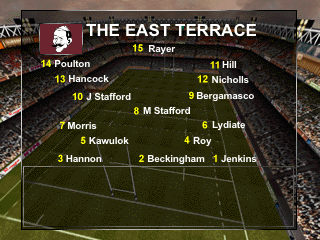
Rage All-Stars were made up of developers who worked on the game and they took advantage of their role in programming the game to give themselves some unique abilities.
It was this team that made Lee Mather a video game legend. Playing on the left wing for the Rage team, he was both the smallest and fastest player in the entire game. In contrast, developer Trevor Williams at full-back was a huge unit (about four times the size of other players) and was about the only other in-game player who was a match for the feared Jonah Lomu in contact.
Mather smiles when asked about his iconic status among Jonah Lomu Rugby fans. ‘I used to sit near Tony McCabe, one of the lead programmers,’ he says. ‘We had previously worked together on the stats for the football game Striker and we got on well. I don’t remember when I found out that he had made me this super player in the game and it didn’t really become a thing until way after when the internet arrived and people started talking about it. I didn’t really consider it beyond thinking it was cool that I was on the team. For some reason, Tony made me really small and really quick for fun.’
When the internet arrived and provided a platform for nostalgic fans to reminisce over their love of the game, Mather couldn’t avoid seeing how beloved his digital doppelganger had become. It seemed that his name was always among the first things discussed when hardcore fans got together and YouTube videos can even be found showing Mather at the peak of his digital rugby powers.
Codemasters too represented members of the company’s staff, including the Darling twins who founded the company (Richard played on the wing and David at fly-half). Codemasters, incidentally, had a small history when it came to rugby, having also published International Rugby Simulator in 1988 for the Commodore, Spectrum, Amstrad and Atari.
The Amstrad rugby version, as previously mentioned on the East Terrace, featured West Germany instead of a playable Wales team and gave five points for a try (at the time, a try was still worth four points).
The final team of the Extra Cup was Team Lomu which contained, as you may expect, 15 Jonah Lomus.
Licensing
Jonah Lomu Rugby was the first rugby game to have licences when it came to player names. Previous rugby games, such as EA Sports’ Rugby World Cup ’95, had lacked this touch, so fans appreciated finally being able to play ‘puppet master’ and control their favourite players in action.
In 2022, All Black winger Jeff Wilson told New Zealand journalist Jamie Wall that it was ‘pretty funny’ being in a video game. ‘I was lightning quick in the game, but any time anyone got near me I bloody dropped the ball,’ explained Wilson. ‘I had to laugh, but I didn’t take offence to it because I’m pretty sure I was the fastest player. No one could move as fast as me.’
Amusingly, the licence didn’t extend to stadium names. Instead, gamers could choose from venues such as Tallfield, Aston Road, Hagley Road and Ballydown Park. The Sydney Morning Herald review of the game in 1997 praised almost everything about the game apart from the limited choice of ‘English’ stadiums.
While fans loved being able to control national teams with real player names and characteristics, it worked out better for some gamers than others. Kiwi gamers got to forever enjoy the thrill of playing with one of the great teams of all time, while Welsh fans were stuck with the haunted bones of the 1995 World Cup team which possessed all the cutting-edge of soft cheese.
The legacy
Despite being released in 1997, the game is still enjoyed by gamers and, incredibly, even professional rugby players. During the 2015 World Cup in England, Drew Mitchell of Australia put out a tweet asking if anyone could help him source a Playstation console and copy of Jonah Lomu Rugby.

Sure enough, rugby Twitter quickly delivered. Not long after the request, fellow Wallaby Matt Giteau shared a picture of a Playstation with a copy of the game that a follower had set him up with. The pair spent plenty of time between real-life matches and training on the console. A few days later, Giteau praised Mitchell as a wonderful rugby player who should be considered among the elite of the sport, but then added how since they had acquired the Playstation he had discovered how ‘bad’ his teammate was at Jonah Lomu Rugby.
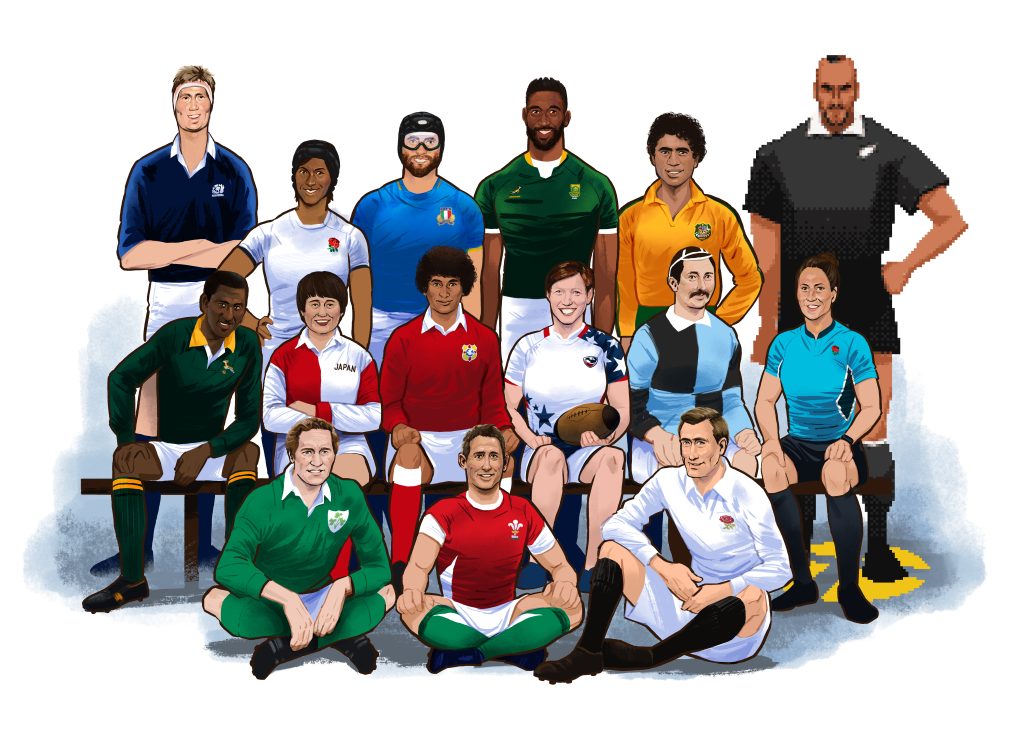
Raluca Moldovan’s cover art for James Stafford’s ‘An Illustrated History of Rugby Rebels, Role Models and Giant Killers’ from Polaris Publishing features a digital version of Jonah Lomu.
BBC rugby presenter Gareth Rhys Owen is one of many in the broadcasting world to still hold a candle for Jonah Lomu Rugby: ‘I used to play it religiously with my brother when I was about 15 or 16. I’m a video game nerd and a rugby nerd. Lomu’s arcade quality was what made it so good. It captured the essence of rugby as it didn’t try to mirror the sport exactly like more modern games have. It was about momentum and it didn’t focus too much on the technical stuff. And rugby is all about momentum. The commentary was incredible and the jokes were lame. They were terrible, but the repetition and humour actually made it work.’
In late 2022, Squidge Rugby (An Illustrated History of Rugby Rebels, Role Models and Giant Killer contains a chapter on Squidge), produced a video of Ospreys players Morgan Morris and Will Griffiths playing a few matches, which thrilled his older audience who remembered the game from first time around and no doubt intrigued those who had only heard of the fabled game but never seen it in action.
Journalist Jack Zorab looks back fondly upon mass competitions played in his school’s common room, where the only rule was no one could be New Zealand due to the unfair advantage the digital Lomu gave people. In 2020, Zorab wrote a wonderful piece called ‘Finding Mather’ which dived into the making of the game and gave many fans a glimpse into the title that they had never had before.
Fans continually upload memories, articles or even game footage onto social media. One of the great finds came in 2023 when a Tom Davies on YouTube uploaded a video of every sprite and frame of animation for the players on Jonah Lomu Rugby (the video is now gone from YouTube but it is preserved on Reddit).
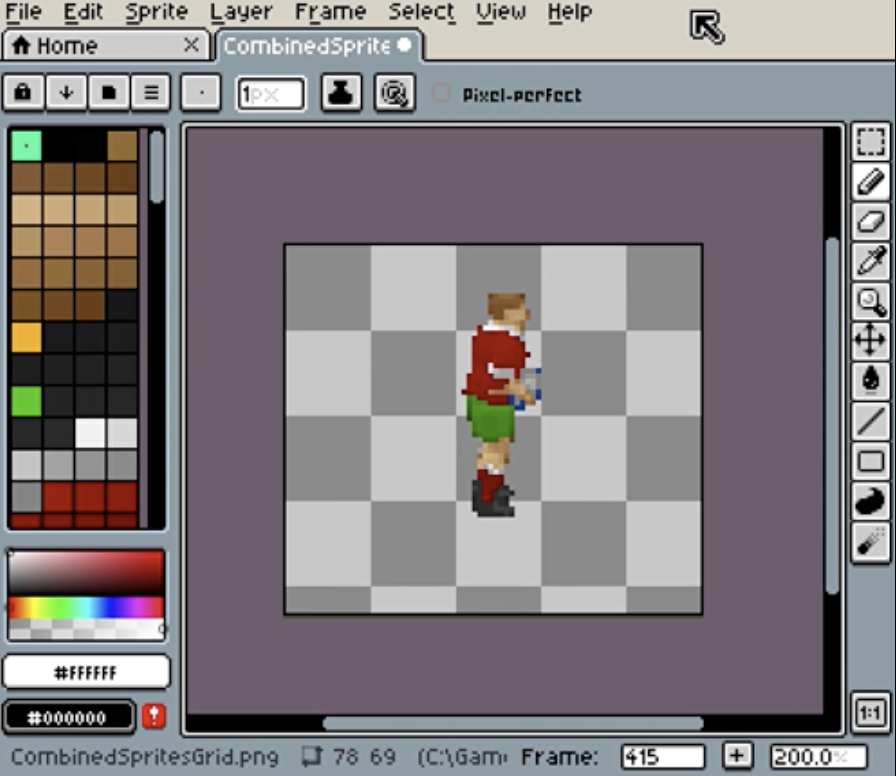
Screenshot of a video showing all player animations from Jonah Lomu Rugby animations.
Amazingly, it showed that animations had even been made for the hooker hooking the ball in a scrum, even though the frames would never be visible to someone playing the game.
Jonah Lomu Rugby is regularly listed as the greatest rugby video game of all time, with newspapers such as the UK’s Daily Telegraph and Ireland’s Irish Independent bestowing that honour upon it.
What happened next?
Publisher Codemasters was acquired by gaming giants Electronic Arts (EA) for $1.2 billion in 2021. Sadly, there was not such a happy outcome for Rage Software. In 1996 it had been floated on the London Stock Exchange and seemed destined for great things.
Unfortunately, an ill-advised venture into publishing proved costly and commercial failures (including a franchise based around football superstar David Beckham) led to the company winding up in 2003. Several of the team that crafted Jonah Lomu Rugby went on to work on 2004’s World Championship Rugby from Swordfish Studios and Acclaim Entertainment. It failed to recapture the magic.
Where is the true successor to Jonah Lomu Rugby? While a fair few argue that Rugby 08 from EA Sports deserves to be talked about in the same conversation, the game never truly gained the cult following that Lomu’s did.
In recent years, prominent figures in the sport have called for World Rugby to use an officially licensed and quality game to drive interest in youngsters who invest so much time and money in other sporting games. So far the appeal has fallen on deaf ears, which some consider ironic considering that Bill ‘I hope not . . .that’s a maternity ward’ Beaumont was chair of World Rugby from 2016 to 2024. Hopefully, one day, a team of developers will emerge from a hole dug by a demented mole somewhere to produce a worthy successor.
(Since the original version of this article was published, Rugby 25 was released, but the universal feeling seems to once more be one of disappointment).
Yet despite no official involvement or movement on a new version, the game itself still evolves with a small community of modders adapting it to reflect the modern game. New Zealander Chris Chen, a software developer who describes himself as being at the centre of a Venn diagram featuring ‘Rugby, Gaming, Software, and the 90s’, has been working for over three years on building a mod that updates the game to include teams, kits and players from modern Super Rugby franchises and national teams.
‘I had the idea to do it in 2015,’ explains Chen. ‘I was sick of waiting for a good rugby video game and wanted to play as the 2015 All Blacks. I was one of those people calling out for ‘them’ to remake JLR with new teams while keeping the same great gameplay. Then I realised I actually had both the skills and the passion to do it. I’ve spent somewhere between 500 and 1000 hours. It’s hard to know. Many evenings and weekends have been spent on it and I’m still actively working on it and adding new features and new teams. My ultimate aim is to create the best rugby video game experience. Imagine the Lomu gameplay but with the game modes and breadth of teams of the top sports games like FIFA and NBA 2K.’
In fact, to celebrate the 20th anniversary of the East Terrace website, Chen built an East Terrace XV which represents, unarguably, the greatest dream team ever assembled in rugby union history. You can read about it here.
As for the fastest winger of all time? Lee Mather now works as senior creative director at EA. And while he may not have been a big rugby fan at the time, he admits that on occasion, he can be found standing on the sidelines at Gloucester or Coventry.
The fans around him, however, have little idea they are in the presence of digital rugby greatness.
All-star teams
Rage All-Stars: T. Williams; S. Williams, O’Dowd, Cooper, Mather; McCabe, Bruce; Theobald, Taylor, Court, Clarke, Howard, A. Williams, Argentieri, Seabridge.
Codemasters: Gaffney; Cummins, Eddy, MacVarish, R. Darling; D. Darling, Smith; Regan, Holley, Osbourne, Bartlett, Walker, England, Gosbell, Urry.
Team Lomu: J. Lomu; J. Lomu, J. Lomu, J. Lomu, J. Lomu; J.Lomu, J. Lomu; J. Lomu, J. Lomu, J. Lomu, J. Lomu, J. Lomu, J. Lomu, J. Lomu, J. Lomu.
Game credits
Programming: Tony McCabe, Steve Williams and Antonio Argentieri
Commentary/audio programming: John O’Dowd
Game design: Tony McCabe, Andrew Hague and Richard Darling
Sound effects and music: Kevin Bruce
Artwork: Gordon Theobald, Lee Seabridge, Andrew Taylor, Claire Cooper, Michael Hanrahan
Motion capture: Rob Callaway
Team information: Lee Mather, Trevor Williams
Commentary: Bill McLaren and Bill Beaumont
Head of production: Steve Holley
Project management: Stewart Regan, Andy Williams and Tony McCabe
Quality assurance: Jason Walker
If you have enjoyed this article, please do share with anyone else you think may enjoy the piece and also please consider sharing on social media.
Feel free to get in touch with your thoughts on either on Bluesky (or Twitter) with @jpstafford.
Thanks to Polaris Publishing for allowing this chapter to be reproduced here on the East Terrace.
Support The East Terrace
Want to support The East Terrace? Buying a book from James Stafford’s ‘Illustrated History of Rugby‘ series helps keep this site going.
It’s always best to support local bookstores, but if you must use Amazon, please also leave us a review if you enjoy one of the books.